History & Trivia
📜 From the Genoese Senate to the Lotto Board: The Ancient Origin of an Italian Game
The Lotto, one of the numerical games most deeply rooted in Italian culture, has its origins in a historical and social context far removed from the idea of "gambling" as we understand it today. Its official birth is firmly linked to the city of Genoa in the 16th century, and its origin is a curious fusion of political necessity, mercantile tradition, and, almost by chance, public entertainment. A fascinating journey that leads us to discover how an administrative need became the precursor of one of the most widespread pastimes in Italy.
🏛 Genoa and the Senatorial Elections: A Problem of Choice

Imagine 16th-century Genoa, a powerful and influential maritime republic, where political life was complex and public offices crucial for the city's well-being. One of the thorniest issues was the appointment of the five members of the Senate, fundamental figures for the management of the State. The candidates were numerous, often between 90 and 120, and the choice was arduous, not without intrigue and factionalism.
To resolve this dilemma, which could generate discontent and divisions, it was decided to adopt a system that would eliminate any suspicion of favoritism: drawing by lot. This method was already in use in other Italian municipalities, but in Genoa, it took a particular form that laid the foundations for the Lotto.
📜 From Names to Numbers: The Transformation of a Practice

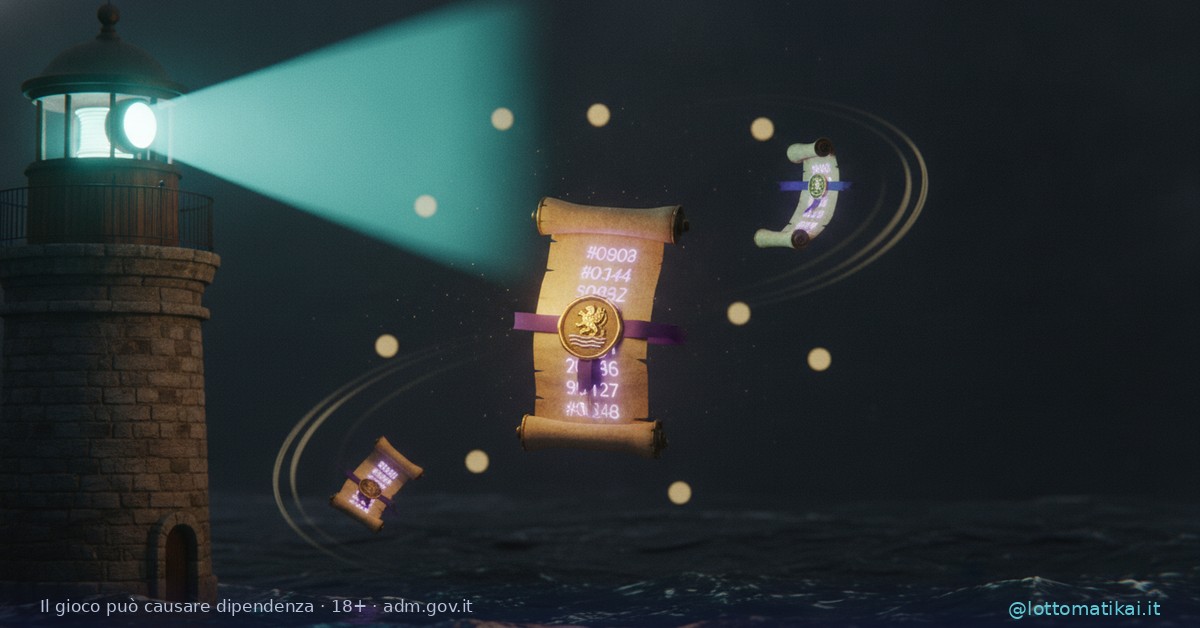
Every year, twice a year, the names of the candidates were written on wooden balls or parchments and placed in an urn. Five were drawn, and these became the new senators. This process, apparently a simple administrative practice, began to arouse some interest among the population.
Citizens, in fact, began to privately bet on which names would be drawn. It was a way to indirectly participate in political life, to express a judgment (albeit informal) on the candidates, and, naturally, to try their luck. This habit, initially informal, spread rapidly.
The crucial step occurred when a Genoese merchant, a certain Benedetto Gentile, had a brilliant intuition. He understood that the interest in the draws was so widespread that it could be standardized. Why bet on names when numbers could be used? The names of the candidates, at that time about 90, were then replaced by numbers from 1 to 90. Each number ideally represented a "place" in the group of candidates.
🎰 The "Lotto of Genoa": Birth of an Organized Game
With this innovation, the game took the form we still know today. Citizens could bet on one or more numbers, hoping that these would be drawn. Five numbers were drawn from an urn containing 90 numbered balls. This was the true "Lotto of Genoa", the progenitor of modern Lotto.
The practice became consolidated and, although initially opposed by authorities for moral and public order reasons, it soon became an important source of income for the State. The bets were no longer private and informal but were regularized and taxed.
An interesting anecdote concerns the figure of the "lottiere," the one who managed the bets and the draws. Often these were charismatic figures, able to attract public attention and create an atmosphere of anticipation and participation during the draw.
🎲 The Evolution of the Wheels: From Genoa to Italy
Initially, the draw only took place in Genoa, but the popularity of the game grew immensely. Soon, other Italian cities, fascinated by this new form of entertainment and the economic potential it offered, began to organize their own draws. Thus was born the concept of "Wheels", each associated with a specific city.
As the Lotto spread, the basic rules remained faithful to the Genoese original: 5 numbers drawn out of 90. What changed was the geographical dimension and the increasingly structured organization of the game, which evolved from a local initiative into a national phenomenon.
The probability of guessing a single number drawn is given by . To guess all five numbers drawn in a specific order, the probability would be much lower, but in Lotto, the order does not matter, so the probability of guessing a quintet is given by a value that clearly highlights the rarity of such an event.
🇮🇹 A Cultural Heritage: The Lotto Today
Today, the Lotto is a game deeply rooted in Italian culture, a weekly ritual that has its origins in a distant era and in a context very different from the current one. From the austere halls of the Genoese Senate to the current live draws, its history is a fascinating example of how a practical need can evolve into a popular pastime, shaping traditions and fueling dreams.
Gambling can cause pathological addiction. Play responsibly. 18+ ADM.
Le performance passate non garantiscono risultati futuri · EV negativo per definizione · 18+ · adm.gov.it