Game Theory & Bias
The Illusion of Patterns: When the Brain Sees Order in Chaos
Our brain is an extraordinary machine, capable of processing an incredible amount of information, learning, creating, and solving complex problems. Yet, sometimes, its innate ability to find patterns and connections can lead us astray, especially when confronted with pure chance. This phenomenon is known as apophenia, a psychological tendency that drives us to perceive significant correlations between random events, seeing hidden meanings where there are none. It's a bit like finding shapes in clouds: we see a dragon or a sheep, but the cloud is just water vapor shaped by the wind.
🎲 The Game of Chance and the Search for Patterns
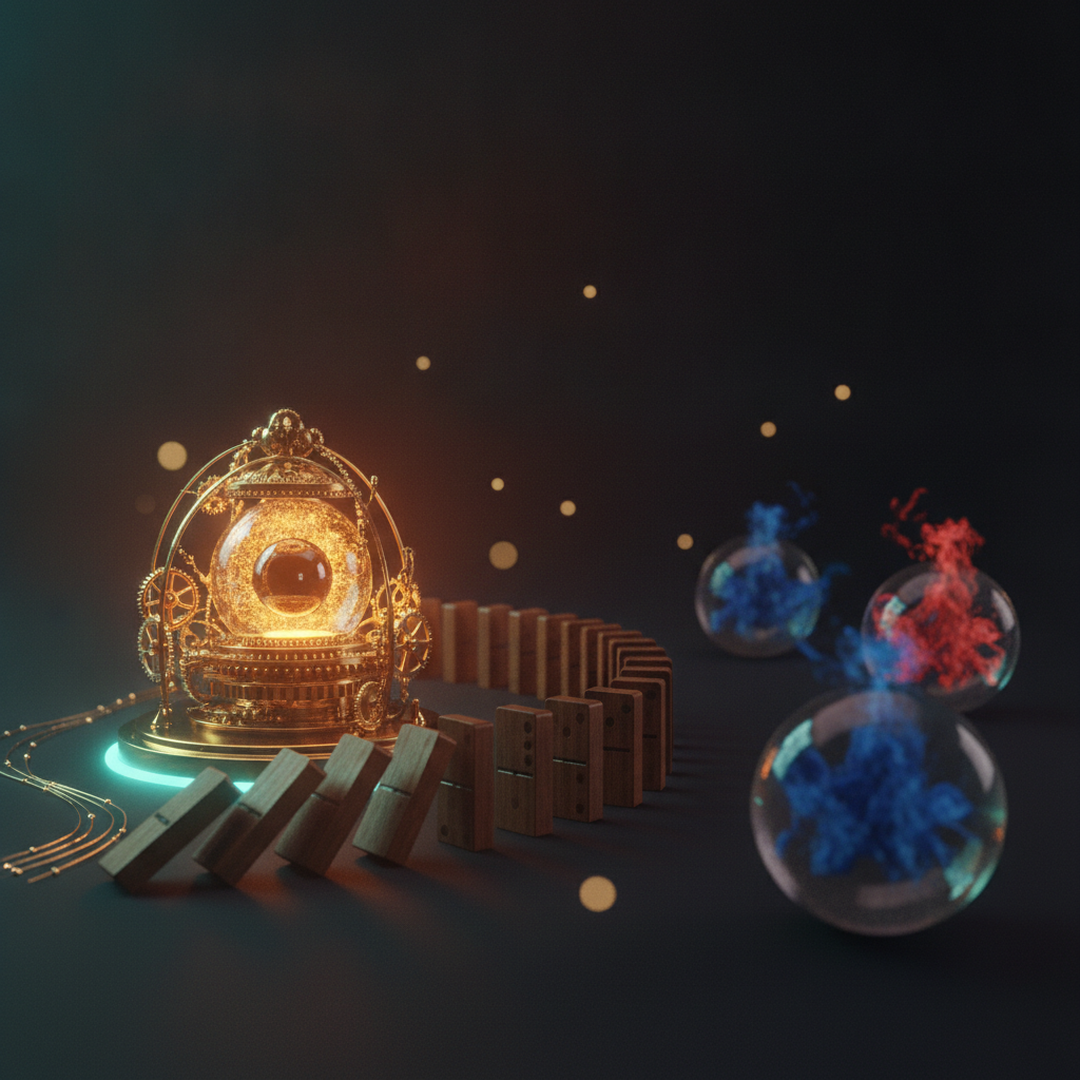
Imagine playing a game of chance based on the random draw of numbers, like roulette or a lottery. The ball has landed on black five times in a row. Many would start thinking: "Now it must be red!". Or, in a dice game, after a series of "1"s, one might be tempted to think that a "6" is imminent. These are classic examples of how apophenia manifests in the context of gambling.
Our brain dislikes uncertainty and pure randomness. It constantly tries to make sense of the world around us, to predict the future based on past models. This tendency was evolutionarily useful for survival: recognizing the rustling of leaves as a potential predator or a particular fruit as edible favored our species. However, when we apply this logic to intrinsically random systems, we create illusions.
🧠 Apophenia: The Brain that Connects the (Non-Existent) Dots

Apophenia is not a disease or a disorder, but an intrinsic characteristic of how our mind works. We see it in action in multiple contexts:
- Numerical coincidences: We find the same number recurring in our lives (date of birth, house number, license plate) and start to think it's a "sign."
- Superstitions: A "lucky charm," a ritual to perform before an important event, arises from the belief that there is a causal connection between two unrelated events.
- Pareidolia: A similar phenomenon, often confused with apophenia, where we see faces or recognizable shapes in inanimate objects or stains.
In gambling, apophenia manifests as the conviction that one can decipher the "signals" of chance. After a series of draws, we might notice that a certain number hasn't appeared for a long time and consider it a "lagging number," or conversely, a number that has appeared often seems "hot" and therefore more probable in the future. Both beliefs are, from a probabilistic standpoint, incorrect.
Let's take the example of a coin: the probability of getting heads is and the probability of getting tails is . If 10 consecutive heads appear, the probability that the eleventh toss will be heads remains . The coin has no memory. Each toss is an independent event. Number draws in gambling games work the same way. The previous draw does not influence the next one.
📉 The Law of Large Numbers and the Error of Judgment
The law of large numbers tells us that, over a very large number of trials, the frequency of an event will approach its theoretical probability. This is true. However, the law of large numbers does not have a "compensating effect" in the short term. There is no mysterious force that "corrects" the sequence of events to restore balance. If the roulette ball has landed on black ten times in a row, it's just a random sequence. It doesn't mean red is "due."
The error lies in confusing long-term probability with short-term probability. Our brain, seeking patterns, jumps to hasty conclusions, interpreting random fluctuations as signals of a trend or an imminent event. This leads to gambling strategies based on unfounded beliefs, which can lead to erroneous decisions and financial losses.
💡 How to Recognize and Manage Apophenia
Recognizing apophenia is the first step to avoiding its traps. Here are some key points:
- Accept randomness: Understand that some events are purely random and do not follow predictable patterns.
- Be wary of "gut feelings": Intuitions based on past sequences in gambling are often misleading.
- Focus on real probabilities: The probabilities of each independent event remain constant, regardless of what happened before.
- Remember the independence of events: In many gambling games, each play is a separate event.
Apophenia is not something to fear, but to understand. Being aware of this tendency of our brain allows us to approach situations more rationally, especially when we are tempted to see patterns where there is only pure, unpredictable, fascinating chance.
Gambling can cause pathological addiction. Play responsibly. Gambling is prohibited for minors under 18 years of age. Source: adm.gov.it.
Le performance passate non garantiscono risultati futuri · EV negativo per definizione · 18+ · adm.gov.it